In the quiet flow of Himalayan rivers lies a treasure that transcends geology, spirituality, and art—the Shaligram. Revered for centuries and cherished by collectors and devotees alike, Shaligram stones are not just religious symbols but also natural masterpieces shaped by time itself. At Rudraksh.info, where art meets meaning, the Shaligram stands as a perfect embodiment of nature’s divine craftsmanship.
What is a Shaligram?
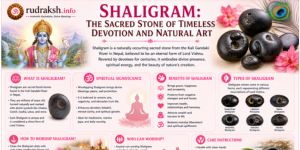
A Shaligram is a fossilized ammonite, typically found in riverbeds, most notably in regions of Nepal. These stones are naturally formed over millions of years and are recognized by their distinct spiral or chakra-like markings. Unlike man-made artifacts, Shaligrams are untouched by human tools, making each piece uniquely authentic.
Spiritual Significance
In Hindu tradition, Shaligrams are considered sacred and are often associated with Lord Vishnu. They are worshipped as living representations of divine energy and are commonly placed in homes, temples, and altars. Unlike idols, Shaligrams do not require ritual consecration, as they are believed to be inherently divine.
Each Shaligram carries different symbolic markings, which devotees interpret as various forms or attributes of divinity. For many, owning a Shaligram is not just about faith but about inviting a sense of peace, balance, and spiritual connection into their space.
A Natural Work of Art
Beyond its spiritual importance, the Shaligram is a marvel of natural design. Its smooth black surface, intricate patterns, and fossilized spirals make it a fascinating subject for art lovers and collectors. No two Shaligrams are alike—each tells a story of ancient seas, geological transformation, and the passage of time.
At Rudraksh.info, we see Shaligrams not only as sacred objects but also as organic sculptures created by the Earth itself. Their aesthetic appeal lies in their imperfections, textures, and the mystery they carry.
Shaligram in Modern Spaces
Today, Shaligrams are finding their way into contemporary interiors—not just as religious artifacts but as statement pieces. Whether placed on a minimalist shelf, within a meditation corner, or as part of a curated art display, they bring a sense of depth and timelessness.
Collectors and designers alike appreciate the Shaligram for its ability to blend spirituality with modern aesthetics. It serves as a reminder that art does not always need a creator—it can be discovered.
Caring for a Shaligram
While Shaligrams are durable, they are treated with respect due to their sacred nature. Many people gently clean them with water and keep them in a dedicated space. Whether you view it as a spiritual object or a natural artifact, handling it with care preserves both its physical and symbolic value.
The Shaligram is more than a stone—it is a bridge between nature, faith, and art. It invites us to pause and appreciate the beauty that exists beyond human creation. At Rudraksh.info, we celebrate such pieces that carry meaning, history, and a quiet elegance.
In a world driven by the new and the manufactured, the Shaligram reminds us of something deeper: that true art is timeless, and sometimes, it is simply found.












Comments